


17 September 2026: Articles 
Delayed Myoclonus and Bilateral Globus Pallidus Lesions Following Organophosphate Poisoning: A Case Report
Challenging differential diagnosis, Unusual setting of medical care, Rare disease
Neetika Sharma ABC 1*, Saravana Sukriya EF 2
EF 2
DOI: 10.12659/AJCR.953336
Am J Case Rep 2026; 27:e953336


Abstract
BACKGROUND: Organophosphate-induced delayed neuropathy is a well-known peripheral nervous system manifestation of organophosphate poisoning. However, organophosphate poisoning can also present with delayed central nervous system complications, such as myoclonus. Although peripheral neuropathy has been extensively described in the literature, central nervous system involvement remains relatively underrecognized. Neuroimaging findings in such cases play a crucial role in revealing the underlying toxic injury and structures involved.
CASE REPORT: A 49-year-old man with organophosphate poisoning recovered from the acute cholinergic phase and intermediate syndrome but developed myoclonus 3 to 4 weeks after organophosphate ingestion. Magnetic resonance imaging (MRI) of the brain showed T2-weighted and FLAIR hyperintensities in the bilateral globus pallidus, suggestive of a toxic insult to the subcortex. The patient received steroids, intravenous immunoglobulin, and symptomatic treatment for myoclonus, with no success.
CONCLUSIONS: This case highlights a unique complication of myoclonus with brain MRI changes in the setting of organophosphate exposure. The patient recovered from acute cholinergic crisis and intermediate syndrome but developed new-onset neurological deficits during the delayed phase. Such complications can significantly contribute to long-term morbidity and impair quality of life. This report highlights a clinically relevant but underrecognized delayed presentation of organophosphate poisoning. Given the limited number of such reports, this case adds incremental knowledge and helps clinicians recognize similar presentations in practice. Although a causal relationship cannot be definitively established, the temporal association raises the possibility of organophosphate exposure and globus pallidus signal changes in the presence of myoclonus.
Keywords: Myoclonus, Neurotoxins, Occupational Exposure, Pesticides
Introduction
Neurological complications of organophosphate poisoning depend upon the type of receptor involved. Central nervous system muscarinic receptor involvement leads to anxiety, restlessness, ataxia, seizures, tremors, coma, and respiratory depression, while nicotinic receptor involvement leads to weakness, paralysis, fasciculations, and cramps. Apart from their presence in the central nervous system, muscarinic receptors are also present on the heart, pupils, exocrine gland, and smooth muscles, thereby resulting in bradycardia, hypotension, blurred vision, bronchorrhea, salivation, and diarrhea, respectively [1]. A case series of 23 adults with organophosphate poisoning reported central nervous system muscarinic involvement in 78% of patients and nicotinic involvement in 17% of patients [2].
Myoclonus is a sudden, brief, lightning-like muscle contraction that can occur from an increase in contraction activity (positive myoclonus) or from the inhibition of contraction (negative myoclonus) [3]. There are multiple causes of myoclonus, including toxin exposure. Twenty-five million agricultural workers globally unintentionally poison themselves with pesticides each year [4]. Exposure to organophosphates causes a significant number of poisonings and deaths annually. The 3 well-known phases of classical organophosphate poisoning are acute cholinergic crisis, intermediate syndrome, and organophosphate-induced delayed polyneuropathy [5]. Rarely, it can lead to other neurological manifestations, such as myoclonic jerks, opsoclonus, seizures, and cognitive disturbance [6,7]. Here, we present the case of a patient with organophosphate poisoning who developed myoclonic jerks and delayed peripheral neuropathy, 2 rare neurological complications of this condition.
Case Report
A 49-year-old man with no prior comorbidities presented with a suspected history of organophosphate poison ingestion. He was found in a drowsy state by family members and was brought to the emergency department. His heart rate was 46 beats/min, and blood pressure was 100/60 mm Hg. On examination, he produced incomprehensible sounds, demonstrated movement of all 4 limbs in response to painful stimuli, and had bilaterally constricted pupils without focal neurological deficits. His clothes had a peculiar smell of organophosphates. Immediate decontamination was performed, including gastric lavage. He was administered atropine and started on a maintenance infusion. Cholinesterase testing was not available at the time of presentation. The diagnosis of organophosphate poisoning was based on the characteristic cholinergic toxidrome, suspected exposure history, the distinctive odor of organophosphate, and the patient’s subsequent admission of organophosphate ingestion. However, 48 hours after admission, he developed tachypnea, with his respiratory rate increasing to 32 breaths/min. The patient’s oxygen saturation level dropped to 80% on room air. He had rapid, shallow breathing with the use of accessory muscles. He had a persistent altered sensorium, which precluded reliable assessment of single breath count and formal bedside pulmonary function parameters. Assessment of neck flexor strength was also limited due to poor cooperation; however, there was an overall clinical impression of declining respiratory effort. Chest examination remained clear, with no crepitations and good air entry. In the appropriate clinical context of organophosphate poisoning, weakness of the respiratory muscles was highly suggestive of impending respiratory failure and intermediate syndrome. In view of impending respiratory failure, the patient was intubated and initiated on mechanical ventilation.
Atropine was titrated, tapered, and discontinued. He gradually recovered from respiratory distress and was extubated after 3 weeks of ventilation. After approximately 3 to 4 weeks of ingestion of organophosphate, he began experiencing myoclonic jerks affecting the trunk and bilateral lower limbs. This jerky movement was so severe that he could not walk unaided and his mobility was limited.
On examination, he was conscious, cooperative, and fully oriented to time, place, and person. Cranial nerves examination was normal. The tone was normal in all 4 limbs. The Medical Research Council power was grade 4/5 bilaterally at the hip, knee, and ankle. Deep tendon reflexes were present in the bilateral knees and absent in the bilateral ankles. Myoclonus was observed in the trunk and bilateral lower limbs when the patient attempted to rise from a sitting position and during ambulation. It predominantly involved the axial muscles, occurred briefly with each voluntary movement, and was not stimulus-sensitive.
Routine laboratory investigations, including a complete blood count and serum biochemistry, were within normal limits. Viral serology for HIV and hepatitis B and C was non-reactive. Nerve conduction studies demonstrated reduced sensory nerve action potential (SNAP) amplitudes in the bilateral ulnar nerves and reduced compound muscle action potential (CMAP) amplitudes in the bilateral peroneal nerves, suggestive of axonal polyneuropathy.
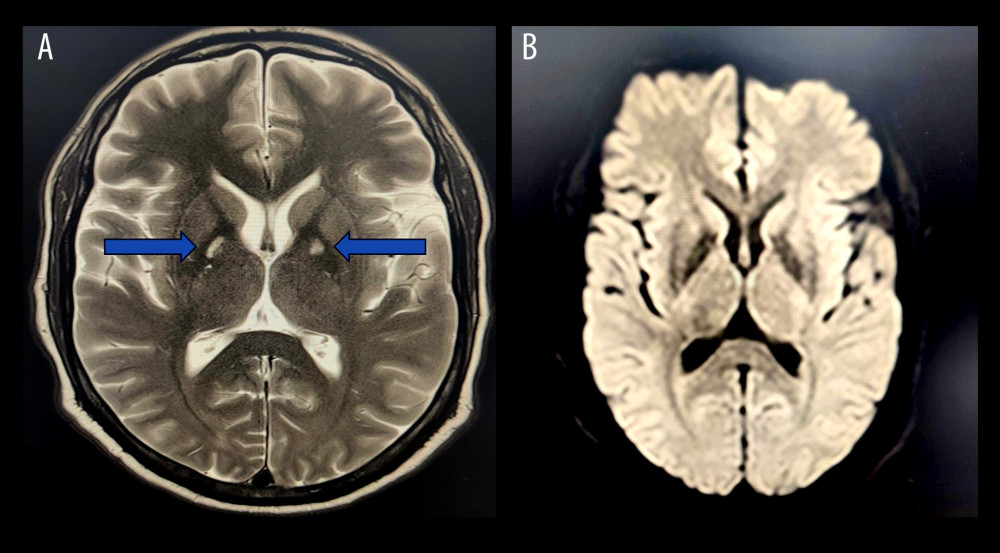
T2-weighted and FLAIR MRI of the brain demonstrated bilateral symmetric hyperintensities in the medial and lateral globus pallidus without diffusion restriction or contrast enhancement, suggestive of toxin-induced injury (Figure 1). MRI of the spine was unremarkable. Electroencephalography did not reveal any cortical spikes or Bereitschaftspotentials. An autoimmune and paraneoplastic profile was done to rule out other treatable etiologies, such as CASPR2 or DPPX-associated encephalitis, and was normal. Given the absence of established treatment protocols, treatment was extrapolated from limited published literature, particularly the case reported by Wang et al, and consisted of intravenous immunoglobulin (2 g/kg divided over 5 days) and intravenous methylprednisolone pulse therapy (1 g/day for 5 days) [8]. However, the patient did not show any clinical improvement with this approach. At 3-month follow-up, myoclonus did not improve, and he was on symptomatic treatment with benzodiazepine and baclofen. On further questioning, he disclosed a history of depressive disorder and admitted to consuming chlorpyrifos. A consultation was sought from the psychiatry team, and he was started on antidepressants.
Discussion
Organophosphate poisoning complications can be divided into acute (minutes to 24 hours), delayed (24 hours to 2 weeks), and late (beyond 2 weeks). Acute neurological manifestations involve anxiety, restlessness, convulsions, weakness, fasciculations, cramps, paralysis, and respiratory depression. Delayed manifestations include intermediate syndrome, coma, and extrapyramidal manifestations, and late manifestations include peripheral neuropathy [9].
In a prospective study of 32 adults with organophosphate poisoning, 53% developed extrapyramidal symptoms, predominantly rigidity (94%), tremors (58.8%), and dystonia (58.8%), but none had myoclonus. These features typically appeared after about a week (median 8 days) of illness and resolved spontaneously within approximately 11 days. Most patients required ventilatory support (84%). Compared with those without extrapyramidal signs, affected patients had significantly longer ventilation (median 16 vs 5 days), longer hospital stay (21 vs 8 days), fewer ventilator-free days, and higher infection rate [10]. Overall, this implies that extrapyramidal manifestations are delayed complications with a more prolonged and complicated intensive care unit stay.
Panda et al highlighted a case of delayed extrapyramidal manifestation as a complication of organophosphate poisoning. A 14-year-old girl, after ingestion of organophosphate pesticide and ventilatory support, developed extrapyramidal gait, dystonia, and hypophonic speech, with MRI showing bilateral basal ganglia hyperintensities [11]. Similar to the previously reported cases, our patient developed delayed extrapyramidal manifestations following clinically supported organophosphate exposure, accompanied by basal ganglia abnormalities on neuroimaging.
Haridas et al described a case of opsoclonus-myoclonus syndrome (OMS) secondary to organophosphate exposure in a middle-aged farmer. The patient initially presented with altered consciousness and respiratory depression, followed by the development of OMS, bronchorrhea, and bradycardia [6]. The case highlights organophosphate poisoning as a rare but important cause of OMS.
The casual association between organophosphate ingestion and myoclonus in our case is difficult to establish. However, we ruled out other possible etiologies. A bilateral globus pallidus hyperintensity ruled out a vascular event. Our patient did not have hypotension or cardiac arrest during the course of the hospital stay, ruling out the possibility of hypoxic damage. The alternative causes of myoclonus, such as metabolic, including renal and liver failure, were not present in our case, and the presentation was atypical for a neurodegenerative disorder, such as prion disease. He was not on treatment for any other illness, and he denied any drug abuse.
Management of delayed organophosphate poisoning complications is still controversial, and treatment recommendations are largely based on isolated case reports rather than established protocols. Wang et al reported a 35-year-old woman with organophosphate poisoning following inhalational exposure, presenting initially with transient loss of consciousness. She was treated with atropine, showed clinical improvement, and was discharged. However, 20 days later, she was hospitalized with headache, vertigo, and memory impairment. MRI of the brain showed diffusion restriction in the splenium of the corpus callosum. She was subsequently treated with intravenous methylprednisolone pulse and immunoglobulins, following which she had complete resolution of symptoms [8]. Based on this limited evidence, we treated our patient similarly; however, no clinical improvement was observed.
The underlying pathophysiology for central nervous system involvement is postulated to be the delayed neuronal destruction of areas of the brain rich in cholinergic neurons, along with exacerbated oxidative stress, imbalanced intracellular calcium homeostasis, and increased cytokines, with changes in cellular signaling affecting cellular metabolism [12,13]. The present case also emphasizes the need to explore the role of immunomodulatory therapies, such as steroids and immunoglobulins, in delayed neurological complications secondary to organophosphate poisoning.
Conclusions
This case highlights a delayed neurological syndrome characterized by myoclonus and bilateral globus pallidus signal abnormalities occurring after organophosphate exposure. The optimal treatment strategies for such delayed neurological manifestations remain unclear and warrant further studies.
References
1. Eddleston M, Buckley NA, Eyer P, Dawson AH, Management of acute organophosphorus pesticide poisoning: Lancet, 2008; 371(9612); 597-607
2. Lee P, Tai DYH, Clinical features of patients with acute organophosphate poisoning requiring intensive care: Intensive Care Med, 2001; 27(4); 694-99
3. Caviness JN, Myoclonus: Contin Lifelong Learn Neurol, 2019; 25(4); 1055-80
4. Alavanja MCR, Introduction: Pesticides use and exposure, extensive worldwide: Rev Environ Health, 2009; 24(4); 303-9
5. Ganie SY, Javaid D, Hajam YA, Reshi MS, Mechanisms and treatment strategies of organophosphate pesticide induced neurotoxicity in humans: A critical appraisal: Toxicology, 2022; 472; 153181
6. Haridas A, Ravi P, Opsoclonus–myoclonus syndrome caused by organophosphate poisoning: Pract Neurol, 2023; 23(3); 243-45
7. Patel A, Chavan G, Nagpal AK, Navigating the neurological abyss: A comprehensive review of organophosphate poisoning complications: Cureus, 2024; 16(2); e54422
8. Wang J, Shao Y, Shi K, Restricted diffusion in the splenium of the corpus callosum in organophosphate induced delayed neuropathy: Case report and review of literatures: Int J Clin Exp Med, 2015; 8(8); 14246-50
9. Peter JV, Sudarsan TI, Moran JL, Clinical features of organophosphate poisoning: A review of different classification systems and approaches: Indian J Crit Care Med Peer-Rev Off Publ Indian Soc Crit Care Med, 2014; 18(11); 735-45
10. Reji KK, Mathew V, Zachariah A, Extrapyramidal effects of acute organophosphate poisoning: Clin Toxicol, 2016; 54(3); 259-65
11. Panda AK, Bala K, Bhirud L, Extrapyramidal syndrome: BMJ Case Rep, 2014; 2014; bcr2013009752
12. Androutsopoulos VP, Hernandez AF, Liesivuori J, Tsatsakis AM, A mechanistic overview of health associated effects of low levels of organochlorine and organophosphorous pesticides: Toxicology, 2013; 307; 89-94
13. Kaur S, Singh S, Chahal KS, Prakash A, Potential pharmacological strategies for the improved treatment of organophosphate-induced neurotoxicity: Can J Physiol Pharmacol, 2014; 92(11); 893-911
In Press
Case report 
Am J Case Rep In Press; DOI: 10.12659/AJCR.953317
Case report 
Am J Case Rep In Press; DOI: 10.12659/AJCR.954643
Case report 
Am J Case Rep In Press; DOI: 10.12659/AJCR.954074
Case report 
Am J Case Rep In Press; DOI: 10.12659/AJCR.953592
Most Viewed Current Articles
07 Dec 2021 : Case report
28,712,429
DOI :10.12659/AJCR.934347
Am J Case Rep 2021; 22:e934347
06 Dec 2021 : Case report  180,530
DOI :10.12659/AJCR.934406
Am J Case Rep 2021; 22:e934406
21 Jun 2024 : Case report
124,276
DOI :10.12659/AJCR.944371
Am J Case Rep 2024; 25:e944371
08 May 2026 : Case report
95,045
DOI :10.12659/AJCR.952158
Am J Case Rep 2026; 27:e952158